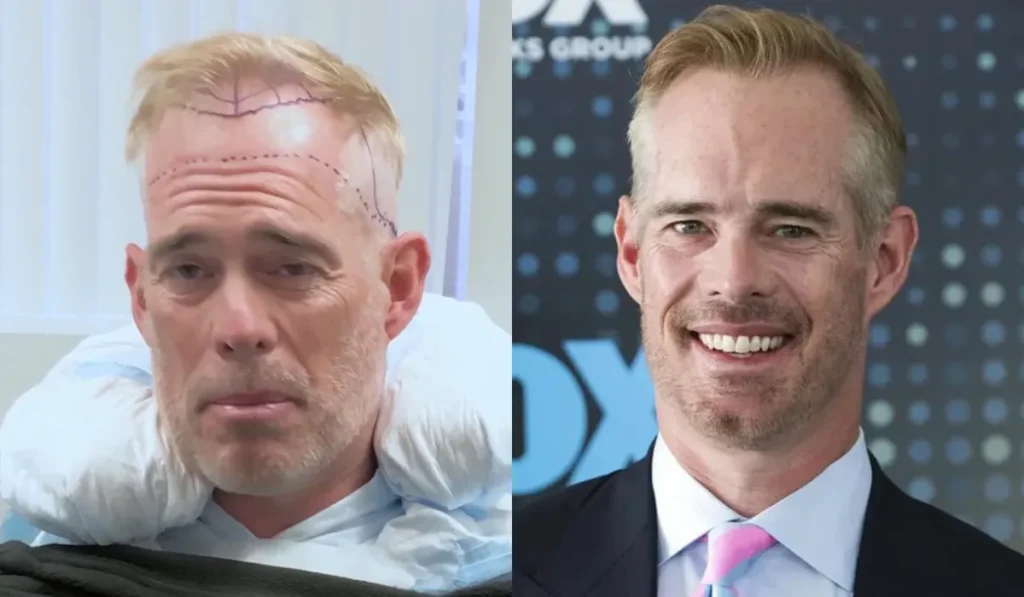
Introduction: The Voice, The Secret, and The Surgery
For decades, Joe Buck has been the soundtrack to American sports, calling the biggest games in the NFL and MLB. However, behind the microphone and the well-coiffed appearance, the famous sportscaster was battling a secret insecurity that nearly cost him his career.
When users search for “Joe Buck hair transplant,” they aren’t just looking for before-and-after photos. They are often looking for the story behind his mysterious voice loss in 2011. In his 2016 memoir, Lucky Bastard, Buck revealed a shocking truth: his paralyzed vocal cord wasn’t caused by a virus, as he initially claimed, but was a complication resulting from his eighth hair replacement procedure.
This article explores Joe Buck’s journey with hair restoration, the dangers of “hair plug addiction,” and how the technology has evolved to ensure safety in 2024.
The Pressure of the Screen: A “Hair Plug” Addiction
Joe Buck admits that his obsession with his hair began early. Being in the broadcasting industry, where high-definition cameras scrutinize every detail, Buck felt immense pressure to maintain a youthful look. He underwent his first procedure in 1993 in New York City.
At that time, hair restoration technology was far less advanced than today’s FUE (Follicular Unit Extraction) or DHI methods. The procedures often involved “plugs” and required significant downtime. Despite this, Buck describes developing an “addiction” to the surgery. He would schedule procedures during breaks in the sports calendar, driven by the fear of losing his hair and, by extension, his on-screen relevance.
The 2011 Incident: How a Hair Transplant Silenced a Legend
The turning point in Buck’s story occurred in 2011. Shortly after undergoing his eighth hair transplant procedure, he woke up unable to speak properly. One of his vocal cords was paralyzed.
For a man whose voice is his livelihood, this was catastrophic. To protect his reputation, he told the public and his employers that he had contracted a virus affecting the laryngeal nerve. It wasn’t until years later that he admitted the cause was likely the surgery.
The Medical Reality: What Actually Happened? It is crucial to clarify that the hair transplant procedure itself (moving hair follicles) did not cause the nerve damage. The culprit was likely the general anesthesia.
- During the surgery, a breathing tube (intubation) was used.
- Medical experts believe the cuff of the tube likely exerted pressure on the laryngeal nerve, causing temporary paralysis.
- This is a rare but known complication of intubation/general anesthesia, not a direct result of extracting hair follicles.
Modern Hair Transplants vs. Joe Buck’s Experience
If you are considering a hair transplant, Joe Buck’s story might seem terrifying. However, the industry has undergone a massive transformation since Buck’s reliance on general anesthesia.
- Anesthesia Protocols: Today, the vast majority of hair transplants are performed under local anesthesia with mild sedation. Patients remain awake and breathing on their own, completely eliminating the need for intubation and the risks associated with it.
- Technique Evolution: Old “plug” methods have been replaced by Sapphire FUE and DHI techniques. These methods are minimally invasive, leave no linear scarring, and offer a much faster recovery time.
- Psychological Screening: Ethical clinics today prioritize patient well-being, often screening for Body Dysmorphic Disorder (BDD) to prevent the kind of “surgery addiction” Buck described.
The Aftermath and Recovery
Fortunately, Joe Buck’s condition was not permanent. Through aid from voice specialists and time, the nerve healed, and his voice returned. His confession in his book broke a significant barrier regarding men’s mental health and vanity.
Buck stated, “I was embarrassed,” highlighting the stigma men face regarding cosmetic procedures. By sharing his story, he normalized the conversation around male hair loss and the lengths men go to fix it. Today, he continues his broadcasting career with a full head of hair and a healthy voice, serving as a cautionary tale about moderation and choosing the right medical approach.
FAQ: Common Questions About Joe Buck’s Hair
- Did a hair transplant ruin Joe Buck’s voice? Indirectly, yes. The vocal cord paralysis was a complication from the anesthesia (intubation) used during the surgery, not the hair grafting itself.
- Does Joe Buck wear a toupee? No. Joe Buck’s hair is the result of multiple surgical hair restoration procedures over two decades.
- Is hair transplant surgery dangerous for your voice? No. Modern hair transplants use local anesthesia. The risk of vocal cord damage is associated with general anesthesia and breathing tubes, which are rarely used in modern hair clinics.
Conclusion: Lessons from a Broadcaster
Joe Buck’s hair transplant journey is a dramatic mix of vanity, fear, and redemption. It serves as a reminder that while wanting to look your best is natural, transparency and safety should never be compromised.
For anyone considering hair restoration today, the takeaway is clear: Technology has made the process safer and more natural than ever before. By choosing a reputable clinic that utilizes local anesthesia and modern FUE techniques, you can achieve the results Joe Buck chased, without the risks he faced.